Okay, Alice Waters makes me tired. She’s domineering, precious and the product of much privilege – privilege she appears incapable of unlearning. In Thomas McNamee’s Alice Waters biography she is quoted regarding the end of her marriage to the effect that she knew her ex was unhappy and felt she made all the big decisions in their lives without his input, but she’d always thought they could work it out. (My paraphrase is probably harsher than her actual words, but the point struck me pretty hard.)
Yet I’m not ready to toss out the Waters' Edible Schoolyard idea like Caitlin Flanagan. And I can not equate gardening with field hand labor, as Flanagan does in her Atlantic article. There is much to learn from the experience of gardening, and it doesn’t necessarily conflict with educational achievements in math and language arts. Flanagan’s piece doesn’t mention that Waters is a trained Montessori teacher when she writes of “her decision in the 1990s to expand her horizons into the field of public-school education.” Regardless of one’s estimation of the Montessori method – I’m agnostic on the subject – Waters is not a dilettante in educational matters.
I know about Waters’ Montessori training because, like Flanagan, I read McNamee’s biography. Presumably Flanagan does, too. And yet she writes that Waters is “someone whose brilliant cookery and laudable goals may not be the best qualifications for designing academic curricula for the public schools.” Cherry pick facts much?
Much of Flanagan’s point revolves around the issue of class. After introducing us to a farm worker’s son who goes to school only to pick lettuce in the hot sun, she writes : “[Waters’] goal is that children might become ‘eco-gastronomes’ and discover ‘how food grows’—a lesson, if ever there was one, that our farm worker’s son might have learned at his father’s knee—leaving the Emerson and Euclid to the professionals over at the schoolhouse." That the farm worker’s son has knowledge on the topic is an interesting point to my mind, and not the least because his knowledge empowers him to own and teach the lesson. He is one sort of expert in the field of study. Leaving geometry and American Transcendentalism to others in favor of lettuce-picking, however, is surely not at issue because there is a garden in the schoolyard. The two are in no way incompatible.
I do not advocate accepting low academic achievement while teaching gardening in schools. That would be just plain stupid. But how much time do the children spend gardening in the project? Ninety minutes a week, according to Flanagan. And then they work in academic classrooms on related projects, which Flanagan believes interferes with mastering the basics of math, science and language arts. I don’t know if this is so, but if it is, it must be improved. Checking the Edible Schoolyard Web site showed me a couple of sample middle school math problems related to the garden and cooking: solving for x and y in a problem that asks the student to double a recipe, and building a model of a garden structure that has these interrelated polygons in these proportions. I’d be interested to see how they stack up against lessons in other 7th and 8th grade math curricula. If they are not up to snuff, then they should be improved. That they refer to the general topic of gardening and food is not itself reason to reject them, however.
I participated in establishing a community garden last year, and the community part of the enterprise amazed me. People who otherwise would never have met collaborated with one another. An artist became the friend of a plumber and a county commissioner. A Glen Beck fan worked along side Obama voters. A Church of the Nazarene preacher assisted non-believers and even a few Hindus make raised beds and plant vegetables. An agricultural science professor and a photographer spread mulch and composted manure.
All these diverse individuals came together because they were inspired by a common project. In one sense any common project – fire house, art gallery, or public restroom – would have done the trick. But that the task involved raising food added meaning to the work beyond a simple common purpose.
Food is important.
Beyond providing mere fuel, food is a part of the external world which has been selected according to custom and tradition, purified by fire and taken into our bodies. What we eat is subject to a symbolic, even spiritual dimension. Not for nothing do Christians profess communion though the symbolic act of eating and drinking. Not for nothing is Passover observed with a meal. Not for nothing is Ramadan a time of fasting. Not for nothing are there dietary laws associated with many great religions.
Alice Waters can be irritatingly foodie-righteous. Anthony Bourdain once compared her to the Khmer Rouge because of her intractability. But I believe she has a point when she asserts out that many of us have lost a meaningful sense of belonging to the earth because of the ways we approach food: industrialized, anonymous, processed beyond recognition. In this she is not alone. We are witnessing a cultural shift in America with respect to food and our relation to it. Alice Waters is only part of the change we are experiencing. Michael Pollan’s books on the subject echo and elaborate on many of her ideas. The connection between processed food and obesity has been researched and documented in physical anthropologist Richard Wrangham’s excellent book “Catching Fire: How Cooking Made us Human.” Michelle Obama’s White House Food Initiative is also part of our changing system of beliefs on the topic.
What I have called a cultural shift Flanagan terms “Food Hysteria.” I assume the difference boils down to duration as much as anything. If my cultural shift jumps the shark next year, it’s Flanagan’s “Hysteria.” It is entirely likely that I am wrong and that I'm merely a faddist, but I am glad we built our community garden. And I’d like to see an edible schoolyard in my little town.
Showing posts with label food. Show all posts
Showing posts with label food. Show all posts
Saturday, January 30, 2010


Sunday, July 19, 2009
More raw footage
PingWire is a live feed of all images posted to one of three sites that host pictures for Twitter users. This means that anything of interest to tweeters for any reason (love, hate, desire, fear, you name it) appears on the site once it has gone through the uploading and publishing process. PingWire offers a glimpse into the collective mind of a significant subset of the Internet -- a visual guide to the unconscious. Like the Internet is dreaming.
Porn is there, of course. So are injuries, tourist destinations, and boyfriends. Last week there were scores of pictures sighted down the picture takers' supine legs at assorted beaches.
It turns out that a sizeable portion of the pictures tweeters share with the world involve food -- eating, cooking, and sometimes growing food. Some photos document a pretty child eating an ice cream cone. Some show empty plates. Others offer scrumptious desserts or elaborate platters of sushi.
Their motives vary widely. Some images appear because a besotted mother wants to show us her son's reaction to (e.g.) a crate of strawberries. Some are offered by disgusted patrons repulsed by the fare at a sub-standard diner. Some are snarky. Some celebrate pleasures.
Many are badly composed and unfocused. Others are professionally exposed ads for restaurants.
Last week I saved as many food and eating pictures as I could during a few hours spread out over four days. I harvested about 1300 pictures during that time. Today, I imported them into a video that turned out to be a little longer than 11 minutes at 1/2 second per image. There is no sound so far, and I'm probably going to rework it considerably, but even the raw footage is interesting to me.
At least it is tonight.
Thursday, July 9, 2009
Raw video
I'm starting to think about food distribution for a show I'm going to participate in this fall. This video clip was shot a couple of days ago in the parking lot of a local supermarket. Sketchy quality video on an iPhone and didactic right now, I guess. But still...
The clip above is one of two I shot on the Fourth -- iPhone video again. It's less didactic than the first one, but food-related nonetheless. Barbecue might the be only valid reason to dump carbon into the atmosphere.
This post might mean my blog is becoming a sketchbook, but I can't yet tell.
Sunday, June 14, 2009
Greening Dallas?
Dallas used to look like the future. Parts of it did, anyway. Logan's Run (released in 1976) was filmed there (also in Fort Worth, Houston, a sewage treatment plant in El Segundo, CA, and other locations). The 1980 PBS TV movie based on Ursula K. Leguin's excellent novel The Lathe of Heaven was shot largely in Dallas, as well. Something about Dallas' sun-baked, concrete public spaces and impersonal, corporatist architecture appealed to filmmakers of the time when it came to imagining, say, the 23rd century. This likely says a lot more about the filmmakers and their audiences than it says about the 23rd century.
It certainly says a lot about Dallas, where the future used to go to get strange.
Another future Dallas was revealed near the end of last month when the winners of the Re:Vision Dallas architecture/urban design competition were announced. The contest invited architects and collaborators in the fields of urban farming, sustainable land use, etc. to create a city block that:
 The image is via the architect's Web site, where several others are available, as are some words which expand on the images:
Meanwhile, up in Milwaukee, a guy named Will Allen -- who last winter was awarded a MacArthur "Genius" Grant -- has worked patiently and persistently to create an urban farm in a blighted neighborhood. He's featured in the trailer below.
(The trailer is from the film Fresh, the Movie, which I have not seen) What I find admirable and encouraging about his project is that it is not the work of designers, but of a man and his compadres who want to make a place to live and live well. There is a connectedness both to a community and to an idea of living with the means of feeding ourselves that really good designers sometimes miss and Dallas implementers of designs have consistently missed.
I mean he's the author of the sentence "And believe in what the worms will do for you."
It certainly says a lot about Dallas, where the future used to go to get strange.
Another future Dallas was revealed near the end of last month when the winners of the Re:Vision Dallas architecture/urban design competition were announced. The contest invited architects and collaborators in the fields of urban farming, sustainable land use, etc. to create a city block that:
encourage[s] and value[s] relationships, while fostering respect for nature and our neighbors, privacy and resources, economy and consumption.One of the three winning designs came from the San Francisco-based firm of David Baker and Partners. It looks like this:
 The image is via the architect's Web site, where several others are available, as are some words which expand on the images:
Rather than simply placing a single building in the middle of a neglected space, the design team's conceptual reach extends beyond the property line into the larger city. The team proposes creating intersecting greenways pieced together from open space and disused lots to set up a framework for future development and to connect existing but disparate public amenities, such as the Farmer's Market and the Trinity River.At the center of the greenways’ "X", Lone Star Square will function as the public heart of the new food/agriculture district, with orchards, garden plots, and historical elements from the city's past. Running through the system of greenways are a series of water features that filter harvested rainwater and convey it in a stream to the agricultural fields to be used for irrigation.
It's good that people in Dallas and elsewhere are looking into future green buildings and alternatives to the dystopic present in which a paucity of shops and amenities, multiple days of unsafe air quality, and oppressive summer heat make the urban experience just plain bad. Like the impossibly strange Dragonfly Building proposed for New York, the project arises from a good heart and good intentions, even if it is a latter day Hanging Gardens of Babylon. And I'm most hopeful for the idea of harvesting rainwater, even though we're now at the beginning of the dry season in this part of Texas, and some parts of the state to our south are well into a drought. But somehow the whole bigass shebang strikes me as just so very Dallas in its scale and structure and attitude. Consultants and experts and government workers decide solutions to problems that earlier consultants and experts and government workers inadvertently created via their solutions to earlier problems.
Meanwhile, up in Milwaukee, a guy named Will Allen -- who last winter was awarded a MacArthur "Genius" Grant -- has worked patiently and persistently to create an urban farm in a blighted neighborhood. He's featured in the trailer below.
(The trailer is from the film Fresh, the Movie, which I have not seen) What I find admirable and encouraging about his project is that it is not the work of designers, but of a man and his compadres who want to make a place to live and live well. There is a connectedness both to a community and to an idea of living with the means of feeding ourselves that really good designers sometimes miss and Dallas implementers of designs have consistently missed.
I mean he's the author of the sentence "And believe in what the worms will do for you."
Monday, June 1, 2009
Found at the market

As Laurie Anderson once sang: "All of nature talks to me. If I could just figure out what it was trying to tell me."
Friday, May 15, 2009
Loaves and Fishes
Let me begin by confessing that I don't know for certain how to say what I want to say right now. Still, I'll try.
We have set up a fledgling community garden here in my little town, and that has led to numerous personal interactions and nascent friendships which I'd never suspected would happen.
More than plants can grow in a garden.
I've made friends with numerous stalwarts in the local Methodist Church, for example -- men and women whose worldview is hardly congruent with my own. I've worked with a man named Bob who is a master plumber and with Jim who is a master welder (and county commissioner) and with Lamont who is a master gardener. So many skills, so many people.
Today, I met (or rather re-met) Tim, a massage therapist and psychologist, who determined that he and his wife Frances needed to participate in the project. After some confusion about which plots were still open (our record keeping needs some fine tuning), we got him situated. The other re-acquaintance today was with Ron, the pastor at the local Church of the Nazarene, who wanted a project for his youth group to work on tomorrow during their weekend famine study. Ron and his church volunteered last month for our Big Event work day when they toted bales and slogged through dirt and mulch till our garden was almost ready for planting.
Yesterday, he emailed to ask if there were chores in the garden for his church's youth group to do during their weekend fast in observance of world hunger.
Wow.
Here's what I learned from Ron: the kids in his church will not eat for 30 hours this weekend. They will work to provide food for others during that time. They will earn money from pledges for each hour they fast. The money will be sent to feed the hungry in Rwanda. He told me that his instructions to them were to learn from their hunger, to understand the relationship between the pangs and their spirits, their souls. His asceticism was heart-felt and heartening, not mean-spirited in the least, but generous and loving.
Understand your luck. Understand the suffering of others. Understand how your spirit is part of this world.
It was an interesting -- even enlightening -- discussion. I mentioned the daily fasting of the faithful during Ramadan, the significance of eating to Christian communion, the ritual of the Seder meal for Jews at Passover. All this (and more) leads me to conceive of food not as mere fuel for our bodies, but as highly charged, symbolic stuff for our souls.
We were on the same page.
We found ourselves -- for the moment, at least -- in absolute agreement. A pastor in the Church of the Nazarene and a secular intellectual nodded and said yes to one another out in a garden with nascent tomatoes and sprouting beans and squash blossoms and okra seedlings and piles of mulch. We didn't and don't agree about theology, ontology, cosmogony, cosmology, ontogeny, ontology, phylogeny, or most other -ogonies, ogenies, and -ologies out there. But when it comes to food, we have common ground. More than that, we want to see another path for understanding our connection to the earth, one in which distinctions between our souls and our bodies amount to so much confused thinking.
Much of that path is bound up in eating.
We have set up a fledgling community garden here in my little town, and that has led to numerous personal interactions and nascent friendships which I'd never suspected would happen.
More than plants can grow in a garden.
I've made friends with numerous stalwarts in the local Methodist Church, for example -- men and women whose worldview is hardly congruent with my own. I've worked with a man named Bob who is a master plumber and with Jim who is a master welder (and county commissioner) and with Lamont who is a master gardener. So many skills, so many people.
Today, I met (or rather re-met) Tim, a massage therapist and psychologist, who determined that he and his wife Frances needed to participate in the project. After some confusion about which plots were still open (our record keeping needs some fine tuning), we got him situated. The other re-acquaintance today was with Ron, the pastor at the local Church of the Nazarene, who wanted a project for his youth group to work on tomorrow during their weekend famine study. Ron and his church volunteered last month for our Big Event work day when they toted bales and slogged through dirt and mulch till our garden was almost ready for planting.
Yesterday, he emailed to ask if there were chores in the garden for his church's youth group to do during their weekend fast in observance of world hunger.
Wow.
Here's what I learned from Ron: the kids in his church will not eat for 30 hours this weekend. They will work to provide food for others during that time. They will earn money from pledges for each hour they fast. The money will be sent to feed the hungry in Rwanda. He told me that his instructions to them were to learn from their hunger, to understand the relationship between the pangs and their spirits, their souls. His asceticism was heart-felt and heartening, not mean-spirited in the least, but generous and loving.
Understand your luck. Understand the suffering of others. Understand how your spirit is part of this world.
It was an interesting -- even enlightening -- discussion. I mentioned the daily fasting of the faithful during Ramadan, the significance of eating to Christian communion, the ritual of the Seder meal for Jews at Passover. All this (and more) leads me to conceive of food not as mere fuel for our bodies, but as highly charged, symbolic stuff for our souls.
We were on the same page.
We found ourselves -- for the moment, at least -- in absolute agreement. A pastor in the Church of the Nazarene and a secular intellectual nodded and said yes to one another out in a garden with nascent tomatoes and sprouting beans and squash blossoms and okra seedlings and piles of mulch. We didn't and don't agree about theology, ontology, cosmogony, cosmology, ontogeny, ontology, phylogeny, or most other -ogonies, ogenies, and -ologies out there. But when it comes to food, we have common ground. More than that, we want to see another path for understanding our connection to the earth, one in which distinctions between our souls and our bodies amount to so much confused thinking.
Much of that path is bound up in eating.
Thursday, April 23, 2009
A second look at the garden
Part I

Back at the beginning of April we had a major work party at the community garden because we were able to plug into a local civic work day called "The Big Event." We had kids from the junior master gardener program out there with us.
 We had guys from fraternities helping out.
 We had geezers with whiskers.
 We had generous people from the town and from local churches.
 An Ag Science professor showed up and broke in his brand new tractor with us.
 Working together, we got a lot done. That morning we moved 130 cubic yards of donated mulch (a cubic yard is 27 cubic feet -- you do the math) and mostly filled 36 raised beds with amended soil.
Part II
Then there was the saga of the bees. My wife and I have lived with a hive of bees for about two years. They've colonized the north wall of our house. I've sporadically tried to get them removed, but the sort of expertise one needs to open a house's wall and capture a hive living inside is rare. I think I have finally found somebody to take care of the hive for me, but he's working long shifts at present and can't do the job for another week or more. I can't bring myself to kill them in this time of Colony Collapse Disorder. Whatever is happening to bees in this country, the bees in my house are definitely healthy.
So healthy that a couple of weeks ago our hive produced two small swarms. Here's a picture of one of them:
 The county extension service put me in touch with a beekeeper by the name of Don who brought a hive box for one swarm and a "catch box" for the other. He left the hive with me and took the other swarm in payment. So a day or so later, I lost my bee hauling virginity when I loaded the hive onto the bed of a borrowed pickup and schlepped them out to the garden site. I waited till they'd gone to bed for the evening and stuffed a dish towel into the entrance, but it was nervous making all the same.
The next day, I hauled them again because we determined they were too close to the garden plots. Now they're about 200 feet away, which seems about the right distance. And they've settled into their new digs quite well.
 I took that photo this afternoon, as well as the one below.
 That's one of our bees foraging about 200 yards from the hive.
Part III

So the garden is beginning to take off. Green stuff is poking out of the soil here and there. A few things are even blooming. The bees are pollinating. I've met and worked with scores of people I wouldn't have otherwise--church folks, politicians, educators, master gardeners, anti-poverty volunteers, plumbers, farmers, and the local feed store proprietors. I've learned a lot about irrigation, mulch, soil amendments, compost, charitable donations, local government, legal matters, insurance, human relations, and bees.
Would Joseph Beuys have called what I've done art? And if he did, would he be right to do so?

Back at the beginning of April we had a major work party at the community garden because we were able to plug into a local civic work day called "The Big Event." We had kids from the junior master gardener program out there with us.
 We had guys from fraternities helping out.
 We had geezers with whiskers.
 We had generous people from the town and from local churches.
 An Ag Science professor showed up and broke in his brand new tractor with us.
 Working together, we got a lot done. That morning we moved 130 cubic yards of donated mulch (a cubic yard is 27 cubic feet -- you do the math) and mostly filled 36 raised beds with amended soil.
Part II
Then there was the saga of the bees. My wife and I have lived with a hive of bees for about two years. They've colonized the north wall of our house. I've sporadically tried to get them removed, but the sort of expertise one needs to open a house's wall and capture a hive living inside is rare. I think I have finally found somebody to take care of the hive for me, but he's working long shifts at present and can't do the job for another week or more. I can't bring myself to kill them in this time of Colony Collapse Disorder. Whatever is happening to bees in this country, the bees in my house are definitely healthy.
So healthy that a couple of weeks ago our hive produced two small swarms. Here's a picture of one of them:
 The county extension service put me in touch with a beekeeper by the name of Don who brought a hive box for one swarm and a "catch box" for the other. He left the hive with me and took the other swarm in payment. So a day or so later, I lost my bee hauling virginity when I loaded the hive onto the bed of a borrowed pickup and schlepped them out to the garden site. I waited till they'd gone to bed for the evening and stuffed a dish towel into the entrance, but it was nervous making all the same.
The next day, I hauled them again because we determined they were too close to the garden plots. Now they're about 200 feet away, which seems about the right distance. And they've settled into their new digs quite well.
 I took that photo this afternoon, as well as the one below.
 That's one of our bees foraging about 200 yards from the hive.
Part III

So the garden is beginning to take off. Green stuff is poking out of the soil here and there. A few things are even blooming. The bees are pollinating. I've met and worked with scores of people I wouldn't have otherwise--church folks, politicians, educators, master gardeners, anti-poverty volunteers, plumbers, farmers, and the local feed store proprietors. I've learned a lot about irrigation, mulch, soil amendments, compost, charitable donations, local government, legal matters, insurance, human relations, and bees.
Would Joseph Beuys have called what I've done art? And if he did, would he be right to do so?
Thursday, April 2, 2009
Our garden
There's a reason I've been less than prolific here on the blog lately. We're creating a public garden here in Commerce, and I've been hauling and trenching and organizing just about full time for the past week and a half. Part time before that.
Here are a few pictures of what we've accomplished so far.
The land we leased hasn't been tilled for about 40 years, so it needed some attention. First it was tilled using equipment that belongs to Cereal Crops Research, Inc., an area non-profit that's been working with farmers in this area for a couple of decades to determine which cultivars are most successful in our climate and our soil conditions. The big John Deere machine below is disking with only its central part as it passes over the heavy "Blackland gumbo" at first. The greater weight on a smaller footprint was necessary to break up the heavy soil. Later the big wings came down for further passes.


After the soil was loosened, we applied two cubic yards of composted chicken manure to the area, and that was tilled in. Next came amendments to loosen the soil further, specifically three truckloads of salvaged potting soil. This was tilled in before it could blow away.


Since this area has been in a steady drought for the past few years, we determined to develop an irrigation plan involving drip lines to conserve water. The plan involved laying PVC pipes underground to each of the 36 individual garden plots. Trenching and plumbing were completed this week.
 While the digging was being done, a few of us also worked on setting the raised beds in place -- no easy task. Those suckers are heavy.


Still to do are moving amended soil into most of the raised beds and mulching the pathways around them. County government has donated about 130 cubic yards of mulch, and we expect a number of volunteers to descend on us Saturday morning in conjunction with a larger civic event scheduled for that day.
This morning the mulch pile was steaming in the cool sunlight.

Our plan is to begin signing up gardeners on Saturday. Planting will commence soon.
Here are a few pictures of what we've accomplished so far.
The land we leased hasn't been tilled for about 40 years, so it needed some attention. First it was tilled using equipment that belongs to Cereal Crops Research, Inc., an area non-profit that's been working with farmers in this area for a couple of decades to determine which cultivars are most successful in our climate and our soil conditions. The big John Deere machine below is disking with only its central part as it passes over the heavy "Blackland gumbo" at first. The greater weight on a smaller footprint was necessary to break up the heavy soil. Later the big wings came down for further passes.


After the soil was loosened, we applied two cubic yards of composted chicken manure to the area, and that was tilled in. Next came amendments to loosen the soil further, specifically three truckloads of salvaged potting soil. This was tilled in before it could blow away.


Since this area has been in a steady drought for the past few years, we determined to develop an irrigation plan involving drip lines to conserve water. The plan involved laying PVC pipes underground to each of the 36 individual garden plots. Trenching and plumbing were completed this week.
 While the digging was being done, a few of us also worked on setting the raised beds in place -- no easy task. Those suckers are heavy.


Still to do are moving amended soil into most of the raised beds and mulching the pathways around them. County government has donated about 130 cubic yards of mulch, and we expect a number of volunteers to descend on us Saturday morning in conjunction with a larger civic event scheduled for that day.
This morning the mulch pile was steaming in the cool sunlight.

Our plan is to begin signing up gardeners on Saturday. Planting will commence soon.
Saturday, February 14, 2009
Cupcakes and presidents
Cake baker extraordinaire, Zilly Rosen has created a double portrait of Obama and Lincoln in the Smithsonian American Art Museum. Her medium was cupcakes. Details of the process are discussed at the Obama Foodorama blog.
Using a grid technique technique much like the great Chuck Close, Ms Rosen and her minions arranged more than 5,900 vanilla cupcakes to recreate a photo of Obama by Annie Leibowitz and another of Lincoln by Alexander Gardener.
The installation is temporary, and the cupcakes are likely already eaten as I type this.
Here's a video of the process:
Online video chat by Ustream
Using a grid technique technique much like the great Chuck Close, Ms Rosen and her minions arranged more than 5,900 vanilla cupcakes to recreate a photo of Obama by Annie Leibowitz and another of Lincoln by Alexander Gardener.
The installation is temporary, and the cupcakes are likely already eaten as I type this.
Here's a video of the process:
Online video chat by Ustream
Wednesday, December 3, 2008
Grass fed
Not long ago my wife and I bought a quarter steer from our egg lady. One of the compensations we get for living in a very small east Texas town (a local monthly calls itself the voice of the Upper East Side of Texas, heh) is that we have access to some incredible tasting, sustainably raised meat and eggs. The egg lady delivers a couple dozen free-range eggs -- okay, the chickens range freely, not the eggs -- regularly. And annually she slaughters a steer, parts of which we have bought on a couple of occasions.
A word about grass-fed beef: it's delicious.
Since the animal spends his life walking around and not penned, it can be a bit chewy if it's over-cooked. On the other hand, exercise gets blood flowing in its muscles and a diet of carotene-rich herbage both adds flavor and makes the fat distinctly yellow. Cattle evolved as grass eaters. They have a digestive system designed by millennia of natural selection to get the most out of a very fibrous, low starch diet. This document from Colorado State begins:

Or maybe not.
The point here is that cattle evolved an extraordinary digestive tract that has nothing to do with eating and digesting grains like corn. Feeding corn to cattle is an industrial agriculture practice and owes its being to economic factors and not good animal husbandry. Basically you can get a steer fatter faster on less land if you feed him corn. But a corn diet can also make the steer sick, so he also gets frequent doses of antibiotics.
The economics of corn are downright Byzantine with market distortions arising from huge agribusinesses like Monsanto and from USDA farm subsidies. Growing corn is also intricately linked to America's consumption of fossil fuels (transportation, processing, fertilizer manufacture, etc.) Michal Pollan's book The Omnivore's Dilemma covers much of this info in engaging detail. Apparently there is molecular evidence that US citizens consume more corn (via corn sweeteners, animal flesh raised on corn diets, and so on) than do Mexicans.
Tonight I cooked a T-bone steak from our quarter steer for dinner. Grass-fed beef. I seared it in a steel skillet and let it rest while I fried some turnip pieces in the pan drippings. When they were nearly done, I added a chopped shallot and later some smoked turkey stock. After reducing the stock, I added some lemon juice and some grated horseradish.
I cut the meat off the bone and sliced it for serving with the turnips and juices. Nobody ate better. It was rich and flavorful and simple and right.
It was a huge steak. There is leftover meat for salads later and the bone and trimmings are in a stock pot simmering as I type.
A word about grass-fed beef: it's delicious.
Since the animal spends his life walking around and not penned, it can be a bit chewy if it's over-cooked. On the other hand, exercise gets blood flowing in its muscles and a diet of carotene-rich herbage both adds flavor and makes the fat distinctly yellow. Cattle evolved as grass eaters. They have a digestive system designed by millennia of natural selection to get the most out of a very fibrous, low starch diet. This document from Colorado State begins:
The rumen is a fermentation vat par excellance, providing an anaerobic environment, constant temperature and pH, and good mixing. Well-masticated substrates are delivered through the esophagus on a regular schedule, and fermentation products are either absorbed in the rumen itself or flow out for further digestion and absorption downstream.It continues:
Feed, water and saliva are delivered to the reticulorumen through the esophageal orifice. Heavy objects (grain, rocks, nails) fall into the reticulum, while lighter material (grass, hay) enters the rumen proper. Added to this mixture are voluminous quantities of gas produced during fermentation.
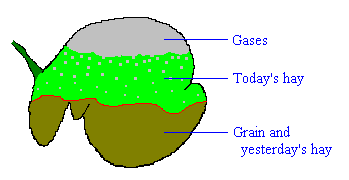
Then comes an illustration that may owe a lot to Carroll Dunham:Ruminants produce prodigious quantities of saliva. Published estimates for adult cows are in the range of 100 to 150 liters of saliva per day! Aside from its normal lubricating qualities, saliva serves at least two very important functions in the ruminant:
- provision of fluid for the fermentation vat
- alkaline buffering - saliva is rich in bicarbonate, which buffers the large quanitity of acid produced in the rumen and is probably critical for maintainance of rumen pH.
All these materials within the rumen partition into three primary zones based on their specific gravity. Gas rises to fill the upper regions, grain and fluid-saturated roughage ("yesterday's hay") sink to the bottom, and newly arrived roughage floats in a middle layer.
Or maybe not.
The point here is that cattle evolved an extraordinary digestive tract that has nothing to do with eating and digesting grains like corn. Feeding corn to cattle is an industrial agriculture practice and owes its being to economic factors and not good animal husbandry. Basically you can get a steer fatter faster on less land if you feed him corn. But a corn diet can also make the steer sick, so he also gets frequent doses of antibiotics.
The economics of corn are downright Byzantine with market distortions arising from huge agribusinesses like Monsanto and from USDA farm subsidies. Growing corn is also intricately linked to America's consumption of fossil fuels (transportation, processing, fertilizer manufacture, etc.) Michal Pollan's book The Omnivore's Dilemma covers much of this info in engaging detail. Apparently there is molecular evidence that US citizens consume more corn (via corn sweeteners, animal flesh raised on corn diets, and so on) than do Mexicans.
Tonight I cooked a T-bone steak from our quarter steer for dinner. Grass-fed beef. I seared it in a steel skillet and let it rest while I fried some turnip pieces in the pan drippings. When they were nearly done, I added a chopped shallot and later some smoked turkey stock. After reducing the stock, I added some lemon juice and some grated horseradish.
I cut the meat off the bone and sliced it for serving with the turnips and juices. Nobody ate better. It was rich and flavorful and simple and right.
It was a huge steak. There is leftover meat for salads later and the bone and trimmings are in a stock pot simmering as I type.
Thursday, October 30, 2008
Pastrami update
The brisket sat in the pickling brine for three days. (A few hours short of the whole 72, actually, but who's counting?) And this evening I dusted it with toasted, freshly ground black pepper and coriander and moved it into the smoker pit.

Because it's supposed to smoke very slowly (Ruhlman and Polcyn write that usually, pastrami is cold smoked before it's finished in a hot smoke environment), I set a pan of ice in the pit with the meat. You can see that even after the 10 minutes or so it took me to get the photo, the ice has begun to discolor from the smoke.
As I write this, the ice is gone and the meat is getting warmer. Currently it's cooking at about 275 F.
I'll have pastrami before bed time.

Because it's supposed to smoke very slowly (Ruhlman and Polcyn write that usually, pastrami is cold smoked before it's finished in a hot smoke environment), I set a pan of ice in the pit with the meat. You can see that even after the 10 minutes or so it took me to get the photo, the ice has begun to discolor from the smoke.
As I write this, the ice is gone and the meat is getting warmer. Currently it's cooking at about 275 F.
I'll have pastrami before bed time.
Thursday, July 31, 2008
Names
Conservative. Liberal. Centrist. Marxist. Fascist. Pissant scum sucking spawn of a three-nippled miscreant who heedlessly drags his scabrous, hairy knuckles over the dried blood of his betters as he slouches towards World of Warcraft and a bag of Cheetos. Defender of traditional culture. Doctrinaire leftist. Troglodyte. Elitist post modernist lackey of an intelectually bankrupt cabal of tomato-nosed poseurs and assorted hillbilly geezers.
Yeah, yeah.
They's out to label us, y'all. They's got these here categories that we all fit. Gotta fit. They's got this here meat axe to help us fit if'n some part of us happens to -- you know -- poke out a bit. A surgical strike on the categorically offending bits 'n' chunks is all it takes to preserve they's ontologically sound categoies.
Take a look at this. It's an essay in The American Conservative by a doctoral candidate in philosophy at UC Berkeley name of John Schwenkler. The topic is food. Food as an economic object. Food as an expression of politics. Food as an integral part of our connection to the earth and to each other.
Food is a portion of the earth which we select with care, ritually purify with fire and take into our bodies. Okay, I added that part myself, but it's not altogether alien from the author's statement that "Leanring to regard a meal as not merely something that fills our bellies and helps us grow, but as the consummate exercise of being carnal and earthbound yet upwardly and outwardly drawn, is a crucial step in the restoration of culture." Not for nothing does the Christian sacrament of communion involve eating. Not for nothing does the Seder revolve around a meal. Not for nothing do the laws of Halal require that each animal slaughtered for food be a sacrifice to God, offered with a prayer. I'm just not altogether certain about the restoration of culture part. Maybe that's just me.
But Schwenkler has other fish to fry. He's looking at the slow food movement and what have come to be called "locavores" and so-called "crunchy conservatives" through the lens of American conservatism. And lo! Alice Waters and Michael Pollan might have some worthwhile things to offer. In fact, except for some "elitist" and "Marxist" lapses in their choice of language, the darlings are actually conservatives!
I'm here to suggest that the labels are less than helpful.
Not far from my home in exurban NE Texas lives a family of evangelicals who home school their too numerous children and raise chickens and lambs. Their farm is beyond organic. No herbicides. No pesticides. No hormones. No antibiotics. No certification of organic status, even (it's not meaningful to their project). They do so for reasons they've derived from their religious practice. They live according to the laws of their faith, as they understand them.
I do not live according to those laws. Lord knows I do not. And yet I've eaten their chicken and the meat of their lambs. I bought those things from them because of my desire to resist factory food. Also because it was delicious. This has nothing to do with the agenda of any political party or with being liberal or conservative. Those are hollow ideas. Empty categories into which we need not fit. Indeed, they are caricatures.
Schwenkler, in fact, exhibits an intelligence which is capable of taking "a closer look" at the pronouncements and stated beliefs of many of the food folk he examines. Looking closer is exactly what is needed, not ideology. What is needed is not a willingness to stuff ideas into an ideologically acceptable Procrustean bed, but a pragmatic approach to specific situations, and he says as much. For too long big corporations and big governmental agencies have made big decisions about our food supply. When I bought half a hog from a local farmer last fall, it came from the slaughter house wrapped in plastic bearing the legend "not for sale." That was because the folks who raised it and the folks who processed it were not big enough for USDA certification. Is my concern about that liberal (don't like big corporations) or is it conservative (don't like big government)?
What difference does it make?
My teacher Joe Barnhardt, who was shot last Sunday because he's a liberal said in a taped interview this week that most liberals he knows are just like most conservatives he knows in that they don't shoot each other about it. He's heir to the great American Pragmatist tradition in philosophy. We need to see what will work. And when it stops working as well as it should, we need to see what else works. We don't really need much by way of names and labels for ideas. Especially not when it leads to ossified thinking.
Worrying about elitists an fuzzy-headed Marxists and whether big government or big business started the agribusiness mess first is supremely unhelpful.
Yeah, yeah.
They's out to label us, y'all. They's got these here categories that we all fit. Gotta fit. They's got this here meat axe to help us fit if'n some part of us happens to -- you know -- poke out a bit. A surgical strike on the categorically offending bits 'n' chunks is all it takes to preserve they's ontologically sound categoies.
Take a look at this. It's an essay in The American Conservative by a doctoral candidate in philosophy at UC Berkeley name of John Schwenkler. The topic is food. Food as an economic object. Food as an expression of politics. Food as an integral part of our connection to the earth and to each other.
Food is a portion of the earth which we select with care, ritually purify with fire and take into our bodies. Okay, I added that part myself, but it's not altogether alien from the author's statement that "Leanring to regard a meal as not merely something that fills our bellies and helps us grow, but as the consummate exercise of being carnal and earthbound yet upwardly and outwardly drawn, is a crucial step in the restoration of culture." Not for nothing does the Christian sacrament of communion involve eating. Not for nothing does the Seder revolve around a meal. Not for nothing do the laws of Halal require that each animal slaughtered for food be a sacrifice to God, offered with a prayer. I'm just not altogether certain about the restoration of culture part. Maybe that's just me.
But Schwenkler has other fish to fry. He's looking at the slow food movement and what have come to be called "locavores" and so-called "crunchy conservatives" through the lens of American conservatism. And lo! Alice Waters and Michael Pollan might have some worthwhile things to offer. In fact, except for some "elitist" and "Marxist" lapses in their choice of language, the darlings are actually conservatives!
I'm here to suggest that the labels are less than helpful.
Not far from my home in exurban NE Texas lives a family of evangelicals who home school their too numerous children and raise chickens and lambs. Their farm is beyond organic. No herbicides. No pesticides. No hormones. No antibiotics. No certification of organic status, even (it's not meaningful to their project). They do so for reasons they've derived from their religious practice. They live according to the laws of their faith, as they understand them.
I do not live according to those laws. Lord knows I do not. And yet I've eaten their chicken and the meat of their lambs. I bought those things from them because of my desire to resist factory food. Also because it was delicious. This has nothing to do with the agenda of any political party or with being liberal or conservative. Those are hollow ideas. Empty categories into which we need not fit. Indeed, they are caricatures.
Schwenkler, in fact, exhibits an intelligence which is capable of taking "a closer look" at the pronouncements and stated beliefs of many of the food folk he examines. Looking closer is exactly what is needed, not ideology. What is needed is not a willingness to stuff ideas into an ideologically acceptable Procrustean bed, but a pragmatic approach to specific situations, and he says as much. For too long big corporations and big governmental agencies have made big decisions about our food supply. When I bought half a hog from a local farmer last fall, it came from the slaughter house wrapped in plastic bearing the legend "not for sale." That was because the folks who raised it and the folks who processed it were not big enough for USDA certification. Is my concern about that liberal (don't like big corporations) or is it conservative (don't like big government)?
What difference does it make?
My teacher Joe Barnhardt, who was shot last Sunday because he's a liberal said in a taped interview this week that most liberals he knows are just like most conservatives he knows in that they don't shoot each other about it. He's heir to the great American Pragmatist tradition in philosophy. We need to see what will work. And when it stops working as well as it should, we need to see what else works. We don't really need much by way of names and labels for ideas. Especially not when it leads to ossified thinking.
Worrying about elitists an fuzzy-headed Marxists and whether big government or big business started the agribusiness mess first is supremely unhelpful.
Thursday, July 24, 2008
Report from San Antonio I
First, all you burglars reading this: we have a house sitter, and he knows where the gun is.
We're in the Alamo City tonight, having driven down from Commerce through the insane traffic in Austin and the torrential rains of Hurricane Dolly's periphery. I have to say that the Prius proved its mettle in Austin's stop-and-go Interstate traffic. We got over 48 miles to the gallon, with some five-minute stretches tallying 100 miles to a gallon (according to the car's computerized energy monitoring system) because we were running mostly on batteries.
But Dolly brought us more than downpours and traffic. The cheap motel I booked for us here is also occupied by scores of evacuees from Brownsville and other hard hit areas of the lower Rio Grande Valley. Many of them are badly behaved, unsupervised children, but then some of the adults aren't exactly Miss Manners either. The stairwell smells like the dumpster behind a KFC franchise, and empty cigarrette packs and crushed styrofoam drink cups litter the halls.
And the TV is broken.
Note to self: look out for evacuees. They aren't especially invested in their temporary digs. But these are easy complaints for me to make. Brownsville got hit with a category 2 storm that messed it up pretty badly. Large portions of the Valley are without power and significantly damaged tonight. Still I sure wish the guy who just knocked on my door by mistake hadn't done that. My gun is back in Commerce with the house sitter.
On the upside, we had a good meal at the Blue Star Brewing Co. just down the road from motel hell, and tomorrow I'm going to hit a few art spots in the same business-cum-art complex. Not all will be stellar, but perhaps a few won't suck. I really don't know what to expect. It's been a long time since I was last in San Antonio.
We've decided that our day will begin with biscuits at the Pioneer Flour mill's restaurant, however, and I know that'll be very good indeed. Those guys have been working on their biscuit recipe for almost 150 years. Crap, they may not be open for breakfast.
My hopes are pinned on brunch.
We're in the Alamo City tonight, having driven down from Commerce through the insane traffic in Austin and the torrential rains of Hurricane Dolly's periphery. I have to say that the Prius proved its mettle in Austin's stop-and-go Interstate traffic. We got over 48 miles to the gallon, with some five-minute stretches tallying 100 miles to a gallon (according to the car's computerized energy monitoring system) because we were running mostly on batteries.
But Dolly brought us more than downpours and traffic. The cheap motel I booked for us here is also occupied by scores of evacuees from Brownsville and other hard hit areas of the lower Rio Grande Valley. Many of them are badly behaved, unsupervised children, but then some of the adults aren't exactly Miss Manners either. The stairwell smells like the dumpster behind a KFC franchise, and empty cigarrette packs and crushed styrofoam drink cups litter the halls.
And the TV is broken.
Note to self: look out for evacuees. They aren't especially invested in their temporary digs. But these are easy complaints for me to make. Brownsville got hit with a category 2 storm that messed it up pretty badly. Large portions of the Valley are without power and significantly damaged tonight. Still I sure wish the guy who just knocked on my door by mistake hadn't done that. My gun is back in Commerce with the house sitter.
On the upside, we had a good meal at the Blue Star Brewing Co. just down the road from motel hell, and tomorrow I'm going to hit a few art spots in the same business-cum-art complex. Not all will be stellar, but perhaps a few won't suck. I really don't know what to expect. It's been a long time since I was last in San Antonio.
We've decided that our day will begin with biscuits at the Pioneer Flour mill's restaurant, however, and I know that'll be very good indeed. Those guys have been working on their biscuit recipe for almost 150 years. Crap, they may not be open for breakfast.
My hopes are pinned on brunch.
Thursday, July 10, 2008
Food
Discussing Michael Pollan's writings about agriculture and our relationship to the things we grow and eat with a friend yesterday evening got me thinking about sustainable agriculture in general and how much the pork chops I smoked for last night's dinner cost in terms of money and petroleum imports in particular.
For folks who may be interested in such things, here are a couple of search engines which specialize in locating purveyors of sustainably produced meats and vegetables within a reasonable distance of your home.
Local Harvest
Eat Well Guide
Entering you zip code and hitting "search" returns information from their databases on sources for pastured meats, free range eggs, organic produce, etc. within a specified radius.
As Joe Bob Briggs used to say: "Check it out."
For folks who may be interested in such things, here are a couple of search engines which specialize in locating purveyors of sustainably produced meats and vegetables within a reasonable distance of your home.
Local Harvest
Eat Well Guide
Entering you zip code and hitting "search" returns information from their databases on sources for pastured meats, free range eggs, organic produce, etc. within a specified radius.
As Joe Bob Briggs used to say: "Check it out."
Thursday, June 12, 2008
Dallas dinner
At the suggestion of a friend we ate at Thai Noodle and Rice on Fitzhugh just east of North Central while we were in Dallas tonight. We hit the ATM on the way because we were forewarned they didn't take credit cards. It was a delight. The whole place has a homemade feel to it right down to the hand-lettered take-out menu: "Hot & spicy make taste."
We had an order of basil rolls, which were spring roll-like concoctions served with a delicious peanut/tamarind dipping sauce. That was the appetizer. One of the main courses was a spicy flat noodle dish with small bits of pork. Wow. The other main was a Thai beef salad, which although it was really good, didn't match the marvelous balance of spice, sweetness and texture of the noodles.
While we were eating, the cook dropped by our table to make suggestions for our next meal there (beef with sticky rice is all I remember). "I try to make it like the original," he said of his cooking. I liked that. Not authentic, but like what he remembers from before he emigrated.
As we prepared to leave, a waitress came by to suggest other tasty choices for our next visit since we like spicy food. I know it's a way of drumming up business for the restaurant, and that's okay. But there's something especially rewarding about seeing people who are both really good at what they do and know that what they do is really good. Having them share it with you is a pleasure.
Our tab was less than $25.
We had an order of basil rolls, which were spring roll-like concoctions served with a delicious peanut/tamarind dipping sauce. That was the appetizer. One of the main courses was a spicy flat noodle dish with small bits of pork. Wow. The other main was a Thai beef salad, which although it was really good, didn't match the marvelous balance of spice, sweetness and texture of the noodles.
While we were eating, the cook dropped by our table to make suggestions for our next meal there (beef with sticky rice is all I remember). "I try to make it like the original," he said of his cooking. I liked that. Not authentic, but like what he remembers from before he emigrated.
As we prepared to leave, a waitress came by to suggest other tasty choices for our next visit since we like spicy food. I know it's a way of drumming up business for the restaurant, and that's okay. But there's something especially rewarding about seeing people who are both really good at what they do and know that what they do is really good. Having them share it with you is a pleasure.
Our tab was less than $25.
Sunday, February 24, 2008
CAA side show
This week the College Art Association held its annual meeting in Dallas, and that means that artist friends from around the country were an hour's drive away from my prairie home. What luck! Wednesday after a department head meeting and after a departmental meeting, I drove into the big city to visit with my friend Kevin and a couple of arts professionals. It was mostly a dinner at an Italian place on Main St. down town. Even though I was pretty winded from all the administrative shenanigans of the day, it was really good to spend some time with a man I respect and to reconnect with his friends Chris and Charla. Chris wrote a decent review of my last show in Kansas when he was living there. Now that he's here with Charla, I probably should do a few things to connect him to the Dallas scene.
Friday night we drove in to the big city again for dinner -- this time with Kevin and John, a friend from back in our days when was working on my MFA in Terre Haute. Nandina was our destination, and it was quite good. But I have to say that the restaurant isn't as fine as our first visit a few years back. And unfortunately Kevin isn't a fan of seafood -- even when it's cooked. So sushi didn't work at all for him.
We hadn't seen John for several years (he's on the faculty of a university in North Carolina), but our conversation never missed a beat. I suppose that's evidence of the nature of our friendship.
Saturday, we met John and his friend David at the conference hotel at lunch time. They wanted barbecue, so it was obvious that Sonny Bryan's was the destination. It's the classic Dallas BBQ joint. They've opened branches in other parts of town, but the original on Inwood is the real deal. I mean, I've eaten at other locations, but BBQ in Macy's at the Galleria somehow misses the mark. We had beef sandwiches, of course.
After lunch, I drove us to the Dallas Center for Contemporary Art so John could see the video show. Next it was Barry Whistler's place where Scott Barber's paintings from the mid 90's are on exhibit. Scott died a couple of years ago -- complications from a bone marrow transplant he underwent to fight a recurring cancer. Some of the last paintings he made were based on photomicrographs from his lab work. Big, generous, and beautiful abstractions derived from images of a disease that threatened his life. Around the corner from Barry's Road Agent Gallery offered a stylish, elegant show of four artists from Chicago. Next we headed up to Dunn and Brown to see Beverly Semmes' outsized dresses. I was able to show John a copy of Trenton Doyle Hancock's book, Me, a Mound, and one of Robyn O'Neil's very large graphite drawings. The two of them graduated from my school a few years back and are responsible for alumni of our program being represented in three Whitney Biennials in a row.
After drinks at the Stoneleigh P, I drove us to S&D Oyster house for dinner. For the table: four beers, two dozen on the half shell, a fried oyster po' boy, two shrimp cocktails with remoulade, two bowls of gumbo, a slice of lemon meringue pie, and two orders of bread pudding.
It's a little embarrassing to confess, but that was my total involvement with the 2008 CAA: Meeting friends from out of town for restaurant meals and a little gallery hopping. Not exactly career building, I suppose.
Friday night we drove in to the big city again for dinner -- this time with Kevin and John, a friend from back in our days when was working on my MFA in Terre Haute. Nandina was our destination, and it was quite good. But I have to say that the restaurant isn't as fine as our first visit a few years back. And unfortunately Kevin isn't a fan of seafood -- even when it's cooked. So sushi didn't work at all for him.
We hadn't seen John for several years (he's on the faculty of a university in North Carolina), but our conversation never missed a beat. I suppose that's evidence of the nature of our friendship.
Saturday, we met John and his friend David at the conference hotel at lunch time. They wanted barbecue, so it was obvious that Sonny Bryan's was the destination. It's the classic Dallas BBQ joint. They've opened branches in other parts of town, but the original on Inwood is the real deal. I mean, I've eaten at other locations, but BBQ in Macy's at the Galleria somehow misses the mark. We had beef sandwiches, of course.
After lunch, I drove us to the Dallas Center for Contemporary Art so John could see the video show. Next it was Barry Whistler's place where Scott Barber's paintings from the mid 90's are on exhibit. Scott died a couple of years ago -- complications from a bone marrow transplant he underwent to fight a recurring cancer. Some of the last paintings he made were based on photomicrographs from his lab work. Big, generous, and beautiful abstractions derived from images of a disease that threatened his life. Around the corner from Barry's Road Agent Gallery offered a stylish, elegant show of four artists from Chicago. Next we headed up to Dunn and Brown to see Beverly Semmes' outsized dresses. I was able to show John a copy of Trenton Doyle Hancock's book, Me, a Mound, and one of Robyn O'Neil's very large graphite drawings. The two of them graduated from my school a few years back and are responsible for alumni of our program being represented in three Whitney Biennials in a row.
After drinks at the Stoneleigh P, I drove us to S&D Oyster house for dinner. For the table: four beers, two dozen on the half shell, a fried oyster po' boy, two shrimp cocktails with remoulade, two bowls of gumbo, a slice of lemon meringue pie, and two orders of bread pudding.
It's a little embarrassing to confess, but that was my total involvement with the 2008 CAA: Meeting friends from out of town for restaurant meals and a little gallery hopping. Not exactly career building, I suppose.
Subscribe to:
Posts (Atom)
